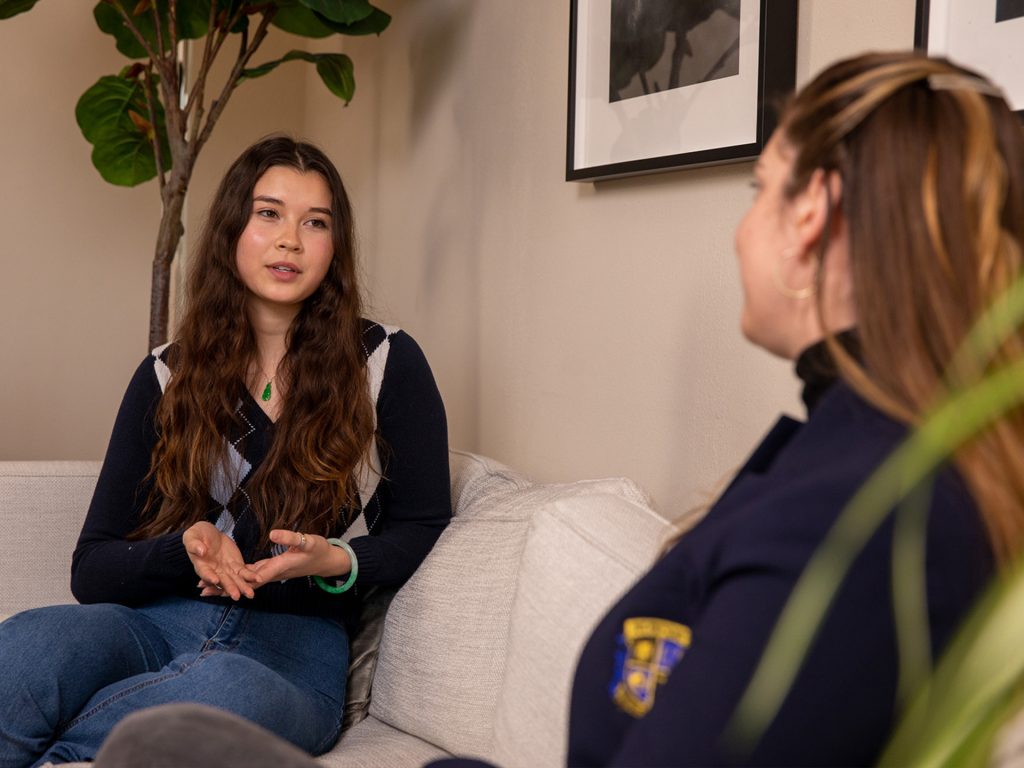


Each patient who arrives at Newport brings different struggles and life experiences. Fears, intrusive thoughts, low self-esteem, and trust issues are just a few of the emotional difficulties young people carry when they suffer with a mental health condition. These are the psychological burdens that Gary Fedoroff, MS, LMFT, CADC II, Newport’s National Director of Experiential Learning, kept in mind when he designed Newport’s Adventure Therapy program.
“When we look at Adventure Therapy, we’re really looking at how can we challenge our patients to walk through some of the things that are holding them back, whether that’s anxiety, limited communication skills, lack of trust, or not having a strong sense of self,” he said.
Adventure Therapy is one of several evidence-based experiential modalities offered in Newport’s treatment programs for children, teens, and young adults. In contrast to traditional talk therapy, experiential therapies, such as art, music, and yoga help young people process trauma and difficult emotions through movement and creative expression. Adventure therapy incorporates physical activities, mostly in an outdoor setting, to engage and challenge young people, supporting them to grow through direct experience.
Adventure Therapy at Newport
Newport’s Adventure Therapy program incorporates a wide range of activities, often informed by natural amenities or landscapes unique to each location. For example, residential and outpatient programs in Orange County take advantage of their proximity to the coast, with activities like surfing, paddleboarding, and kayaking. Minnesota patients, meanwhile, might take part in ice fishing or conquer indoor exercises like rock wall climbing or Mixed Martial Arts.
Depending on location, Adventure Therapy at Newport may include:
- Ropes courses
- Mountain biking
- Skate park
- Obstacle course
- Indoor climbing
- Surfing
- Hiking
- Kayaking/paddleboarding
- Mixed Martial Arts
- Fishing
- Building projects
- Sports games
- Slacklining
“With the compassion and support and leadership of the therapists who are facilitating these groups, we’re helping patients build versions of themselves that they didn’t think they were capable of building.”
Gary Fedoroff, National Director of Experiential Learning
Goals of Adventure Therapy Groups
Adventure Therapy offers an excellent opportunity for young people to build critical life skills and experience personal growth in a safe, supportive environment. Beneficial for individuals of all ages, research shows Adventure Therapy is an effective tool for overcoming a wide range of mental health conditions, including anxiety, depression, eating disorders, and problem substance use. Plus, there is the added benefit of combining physical activity with the healing power of nature.
The goal of the program is to help each client:
- Improve self-esteem
- Increase self-advocacy skills
- Facilitate peer support to develop rapport and authentic connections
- Encourage pro-social activities and behaviors
- Build trust in self, peers, and adults
- Increase resilience and confidence to overcome obstacles
Finding Hidden Strengths
Another beautiful thing about the program, Gary said, is its adaptability. Not every client can excel at every activity, but facilitators will work to find one that taps into their strengths, even if the patient doesn’t realize it yet. He shared that one young man—as hard as he tried and as much as he wanted to—just couldn’t do the physical challenges. So Gary decided to challenge him in a different way. He took the group to an escape room, where the young man quickly emerged as a leader, guiding the rest of the group to interpret the clues that would lead them out of the enclosed space.
“He shined. He took the leadership role, and he totally became the star. And that is the therapeutic value. That’s what we’re trying to create.”
Gary explains that while there are definite therapeutic benefits to the program, not every activity needs to have a specific clinical focus. Patients come to Newport at a tumultuous time in their lives, and sometimes they just need to get out and do something fun. “There’s therapeutic value in that,” he said.
Overall, Gary is proud of the program, its impact on patients, and the emphasis Newport places on its value. “That’s why we’re the best when it comes to experiential learning,” he said.

Building Resilience, Confidence, and Authentic Connections
Each Adventure Therapy activity is tied to an objective that aligns with what patients are working on in therapy. For example, an obstacle course shows young people that they can overcome difficult things, and that when they fall, they must get back up again and face their fears. Kayaking and paddleboarding provide a solitary opportunity for patients to manage their intrusive thoughts, while fishing teaches patience and how to accept a disappointing outcome. And a simple hike creates a sense of community and togetherness among the group.
Adventure Therapy groups include two components: the activity itself and the process group. The process group is an opportunity for the facilitator to encourage the patients to reflect on the parallels in their own life experiences and the activity. And sometimes the facilitator gets creative, adapting an activity to help a client overcome a personal roadblock.
Customizing the Experience
The Adventure Therapy ropes course in Orange County, Gary said, provides a unique opportunity to customize an excursion to address individual struggles. This 60-foot-high climb increases in difficulty as participants reach the top and ends with a thrilling zipline back to the ground.
Gary recalls two young male patients, one who struggled with communication, the other with trust. So, he had an idea. He blindfolded the boy with trust issues and asked the other boy to lead him through the challenge. This approach not only required exceptional teamwork but also allowed each boy to face his own fears and personal battles. “It forced them outside of their comfort zones in a very safe way,” he said.
He said it’s a powerful moment when the facilitator gets to see a patient complete a challenge that they were initially afraid to take on.
“With the compassion and support and leadership of the therapists who are facilitating these groups, we’re helping patients build versions of themselves that they didn’t think they were capable of building.”
Results-Driven Mental Health Treatment
If you are a parent or referring care provider who knows a child, teen, or young adult who could benefit from treatment, Newport is here to help. With 70+ residential programs and 20+ outpatient programs in a dozen states across the country, and in- and out-of-network partnerships with a large array of insurance providers, we make mental healthcare more accessible and affordable to families. Contact us to learn more.
About Gary Fedoroff
Gary has been working with high-risk teens for nearly 15 years, in settings ranging from community centers to juvenile drug court. He excels in treating adolescents who have lost a sense of connection to self and others, and who are open to new experiences and activities that help them build self-esteem and perspective. Prior to moving into his current role, in which he develops and implements curriculum for Newport’s Adventure Therapy program, Gary served as our Program Coordinator of Intensive Outpatient Services.